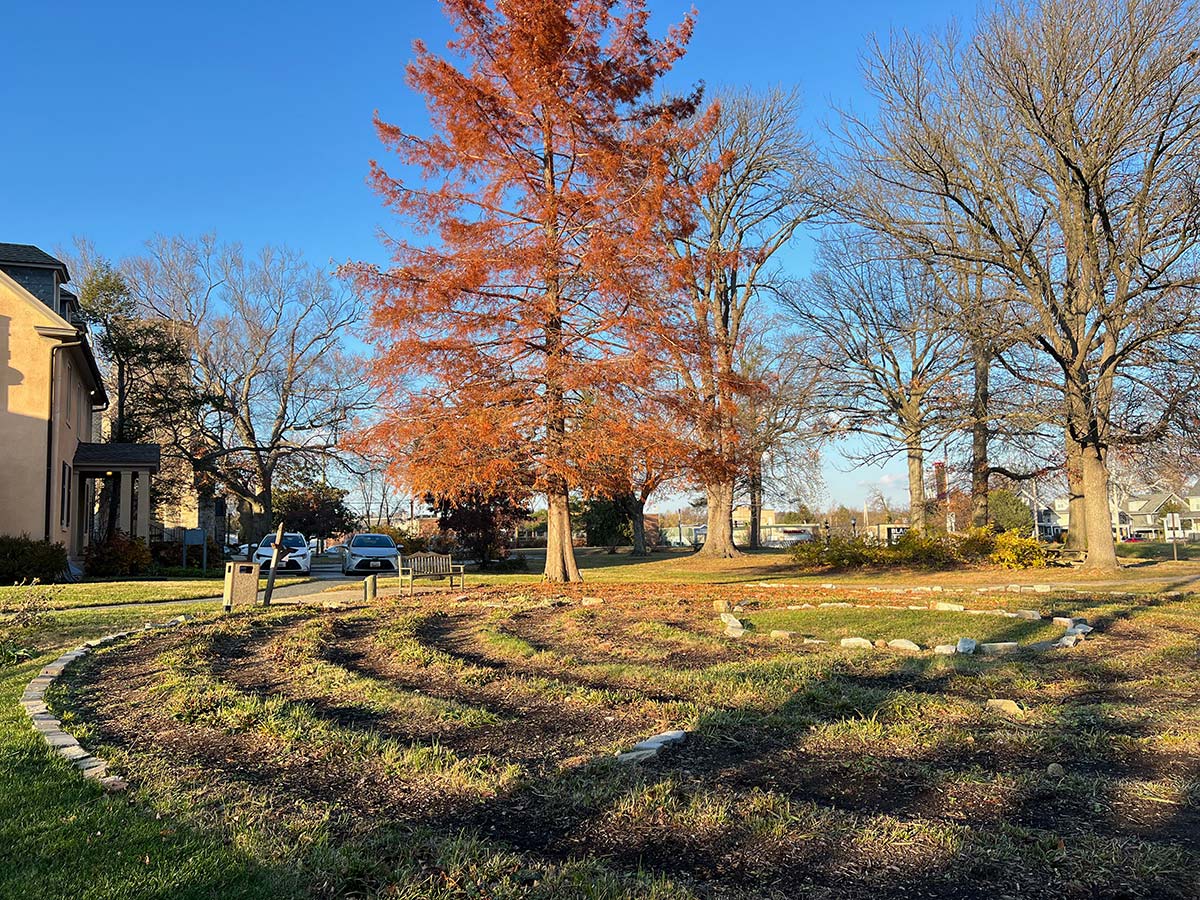
The decades haven’t always been kind to the Santa Rosa Labyrinth at Govans Presbyterian Church.
The circular walkway was installed in 1999 outside the landmark house of worship in north Baltimore. It was part of a rediscovery then going on around the country of the spiritual powers of labyrinths, which trace their history to prehistoric times. Greek mythology holds that one was built to contain a half-man, half-bull minotaur.
Govan’s labyrinth had fallen into disrepair until a group of volunteers recently undertook a major revitalization that is still underway. Working with a master gardener who lives in the area, they have replaced non-native plants with native ones and installed a new bench complete with a journal for people to record their experiences.
Church members, students from area schools and horticulturists needing experience for certification as master gardeners have pitched in. Nature Sacred, an Annapolis-based foundation, donated money. Blue Water Baltimore’s nonprofit Herring Run Nursery helped procure plants native to the Chesapeake Bay watershed.
“It’s been kind of a community effort as well as a church one.” says Govans member Claire Storey. “It’s amazing how much work is being done.”
The labyrinth was originally the brainchild of then-pastor Jack Sharp. It utilized a design created by artist Lea Goode-Harris and named for the California town of Santa Rosa.
“It was an avenue to spirituality,” says Govans member Bonnie Thomson, who has been involved in the project since the beginning.
According to the Labyrinth Society of Hilton, New York, “Labyrinths have held significance for many cultures around the world for thousands of years, appearing as a symbol in a mythology, a protective image on doorways and buildings, as well as processionary pathways in places of worship and on remote islands, hilltops and headlands.”
They are distinguished from mazes, which have dead ends designed to trick the traveler, in that they have a single path leading to a center and back out again.
Users of Govan’s labyrinth have been spotted quietly meditating or even dancing on the path. Others have been moved to tears.
“It can be a personal thing,” Thomson says. “It’s the journey not the destination.”
by Jon Morgan